India and China Innovation
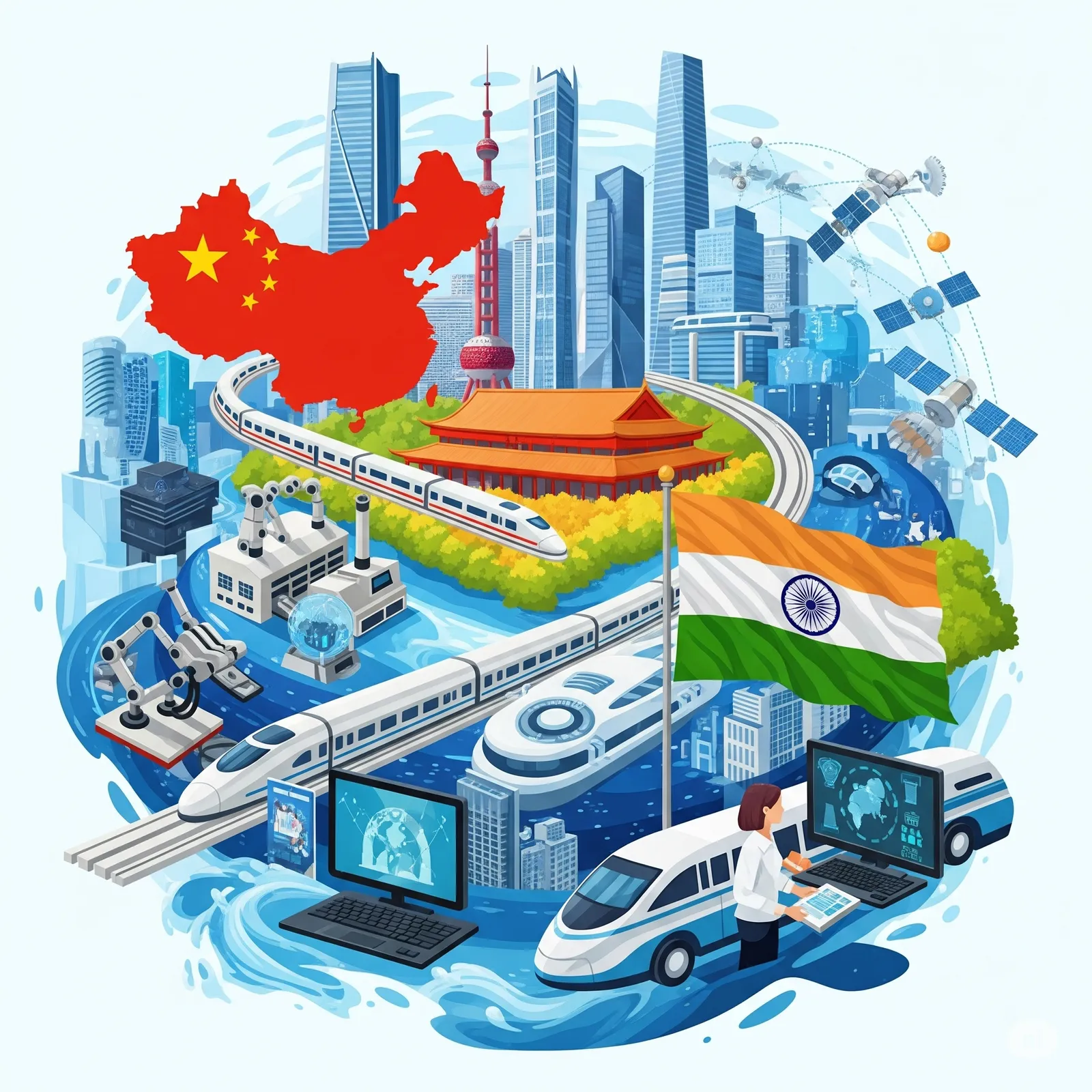
As the world pivots toward knowledge-based economies, the strength of a nation lies increasingly in its ability to innovate, produce scientific knowledge, and adapt its education systems. Both India and China have taken ambitious steps in building their STEM (Science, Technology, Engineering, Mathematics) ecosystems. But where China has aggressively scaled innovation and institutional reform, India now stands at a crossroads with a chance to rethink its higher education model—not just for STEM but for STEAM (STEM + Arts), which emphasizes creativity and interdisciplinary learning.
🚀 Why STEAM, Not Just STEM?
While STEM has served as the backbone of industrial and technological revolutions, the integration of Arts brings critical thinking, communication, empathy, and design thinking to the forefront. Countries like South Korea and Finland have already embedded arts into their national curricula, emphasizing that creativity is a critical part of innovation.
India, with its rich cultural and artistic legacy, has an opportunity to build a uniquely Indian STEAM model—merging traditional wisdom with scientific rigor.
📊 India vs. China: A Comparative Snapshot
Here's how India and China stack up on key education and innovation parameters:
| Category | China | India |
|---|---|---|
| Global Innovation Index 2024 | 11th globally – only middle-income economy in top 30 | 39th globally – 1st among lower-middle-income economies |
| Patent Applications (2023) | World leader in total filings | 82,811 filed; domestic filings surpassed foreign; 13.5% increase in grants |
| Scientific Publications | World’s largest producer of research papers since 2017 | Growing output but significantly behind China |
| Universities | 3,074 universities; >47.6 million enrolled students | 760 universities (as of 2015); >38,000 colleges |
| Schools (CBSE Affiliated) | Not applicable (different structure) | ~29,179 schools under CBSE |
| Science & Tech Clusters | 26 clusters in Global Top 100 (GII 2024) | 4 clusters (Mumbai, Delhi, Bengaluru, Chennai) in Global Top 100 |
| Innovation Characteristics | High-end innovation in AI, semiconductors; strong R&D investment | Known for frugal and grassroots innovation; emphasis on scalable models |
| Higher Education Reach | World’s largest higher education system | One of the world’s largest but with lower funding per institution |
| Government Investment in R&D | High (approx. 2.4% of GDP) | Low (approx. 0.7% of GDP) |
🏫 The Education-Research-Innovation Nexus
China's Strategy:
Massive investment in higher education and R&D.
Encouraged collaboration between industry and academia.
Focused heavily on IP generation and commercialization.
India’s Opportunity:
Increase R&D funding in both public and private sectors.
Integrate STEAM across school and college curricula.
Promote research and patent culture from the undergraduate level.
🧠 The Role of Arts in Technology
STEAM encourages:
Design Thinking: Crucial for product development and user-centric solutions.
Communication: Engineers who can pitch and write well attract funding.
Empathy: Needed in healthtech, edtech, and civic innovations.
Art in technology is not ornamental—it's functional.
🔄 Rethinking India's Higher Education Model
To match or even outpace China's STEM accomplishments, India must:
Move away from rote-based learning.
Incentivize interdisciplinary research.
Strengthen academia-industry-government collaborations.
Build global-standard research infrastructure.
Embrace arts and humanities to cultivate adaptable, innovative minds.
🌏 Conclusion
India has already demonstrated potential—especially with grassroots and frugal innovations. However, to scale that success and compete with China, the nation needs to leverage its demographic dividend through a revamped STEAM-powered education system.
The future isn’t just about engineers and scientists. It’s about creators, communicators, designers, and thinkers—who innovate not just in labs, but in society.
📚 References
WIPO Global Innovation Index 2024 – WIPO GII Rankings
World Intellectual Property Indicators 2023 – WIPO
India Patent Office Annual Report 2023 – Controller General of Patents, Designs and Trademarks (CGPDTM)
Nature Index 2023 – Research output by country
China Education Statistics 2023 – Ministry of Education, China
All India Survey on Higher Education (AISHE) – Ministry of Education, India
CBSE Official Website – https://www.cbse.gov.in
Frugal Innovation and India’s Role – C.K. Prahalad’s work on “The Fortune at the Bottom of the Pyramid”
Economic Times Commentary (March 2024) – Can India Match China's STEM Success?
UNESCO Institute for Statistics – R&D Expenditure Data