Fog Harvesting
Picture this: It’s early morning in the dry, rocky hills of Rajasthan. The sky is foggy, visibility is low, and the air is thick with moisture—but not a single drop of rain is expected. Now imagine that same fog is turned into clean, drinkable water, flowing into tanks that serve a local school or village. This is not fiction. This is fog harvesting—a low-cost, low-energy water solution that could transform the way India fights water scarcity.
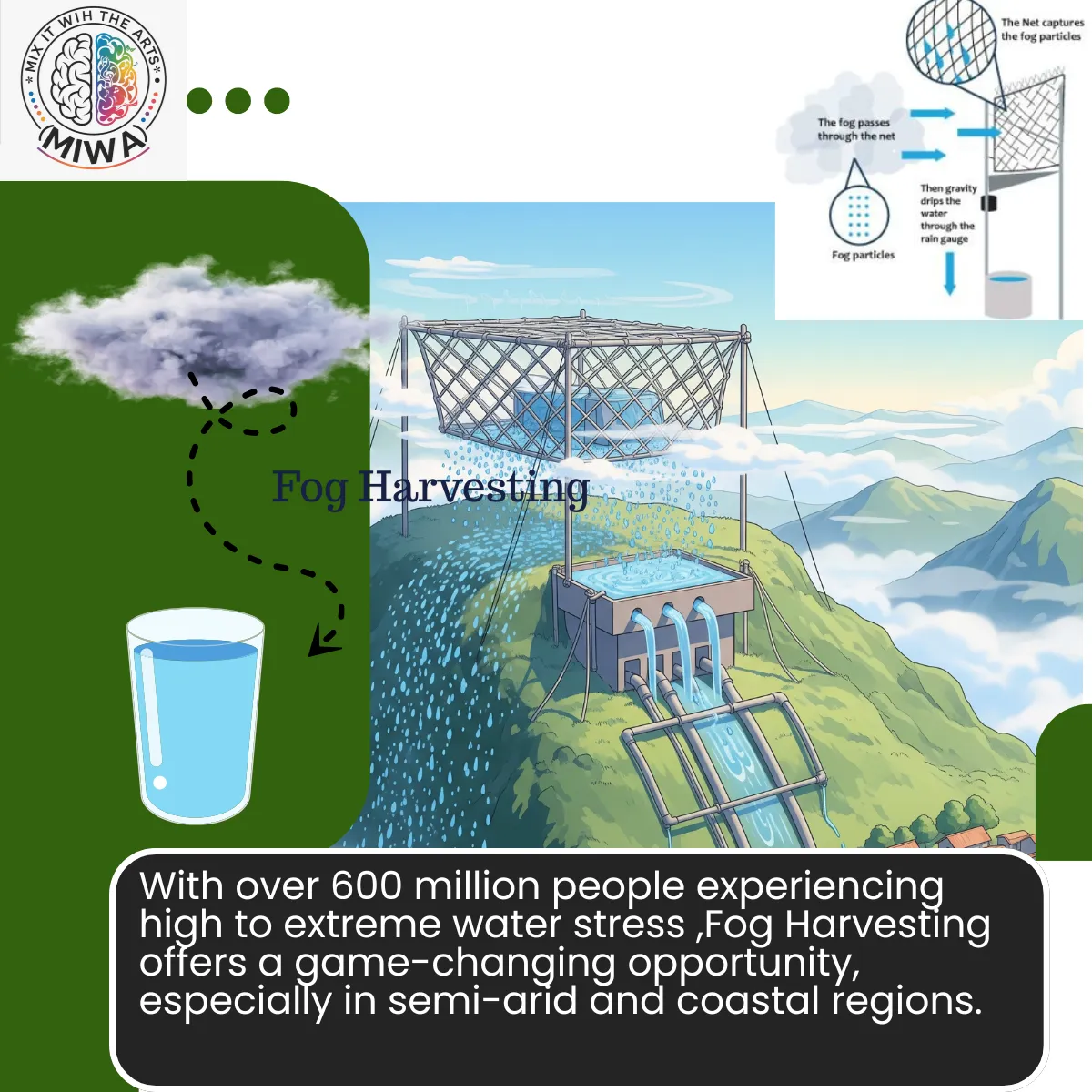
Fog harvesting is the process of collecting water droplets suspended in fog using specially designed vertical mesh nets. As fog passes through the mesh, tiny water droplets condense, trickle down, and are collected in storage containers. It requires no electricity, just smart design, positioning, and community involvement. With India facing growing climate uncertainty and over 600 million people experiencing high to extreme water stress (NITI Aayog, 2019), this method offers a game-changing opportunity, especially in semi-arid and coastal regions.
🔬 Fog Harvesting Through the Lens of STEAM
What makes fog harvesting a perfect example of STEAM education (Science, Technology, Engineering, Arts, Mathematics) is how it blends scientific thinking with social innovation:
Science helps us study atmospheric humidity, wind direction, and dew points—factors that influence fog density and condensation.
Technology brings in materials innovation, like hydrophobic coatings or solar-powered pumps to improve efficiency.
Engineering ensures the fog nets are structurally sound, withstand wind loads, and are easy to maintain with local tools.
Art and design play a key role in ensuring that these systems are aesthetically integrated into villages, schools, and eco-parks—places where public acceptance matters.
Mathematics helps calculate water yield per square meter, assess return on investment, and scale installations.
In schools and innovation clubs, Indian students can experiment with fog-catcher prototypes using mosquito nets, recycled materials, and simple frames to learn real-world physics and problem-solving—all while contributing to their local communities.
Where Fog Harvesting Can Help in India
Several regions in India are ideal candidates for fog harvesting:
Rajasthan’s Aravalli Hills and Mount Abu, where early morning fog is frequent and local communities face water scarcity.🗒️ Source: Central Ground Water Board (CGWB) reports on Rajasthan's groundwater stress and fog incidence patterns (CGWB, 2021).
Coastal Tamil Nadu, particularly around Kanyakumari and Puducherry, where sea breeze-driven fog rolls in during monsoon and post-monsoon seasons.🗒️ Source: Tamil Nadu State Action Plan for Climate Change, 2022; IMD climatological data on coastal fog frequency.
Saurashtra region in Gujarat, where hilly terrains near the Arabian Sea trap fog but lack year-round water access.🗒️ Source: Gujarat State Climate Change Knowledge Portal and IIT Gandhinagar's water resources studies.
Pilot projects can begin in rural schools, forest outposts, or border villages where
transporting water is costly and energy-intensive. By building local prototypes, training youth through tinkering labs, and involving community organizations, fog harvesting can become a scalable and inclusive solution.
💬 Marketing and the Human Element: The ‘A’ in STEAM
No innovation spreads unless it’s embraced by people—and that’s where the often-underestimated ‘Arts’ and soft skills of STEAM come into play.
To promote fog harvesting in India:
Storytelling can help change perception—turning fog from a nuisance to a resource.
Community design workshops can ensure the structures are locally accepted and culturally relevant.
Social entrepreneurship can frame fog harvesting as a livelihood opportunity—for rural women or youth groups.
Civic empathy and communication can empower students, educators, and NGOs to collaborate and co-create with villagers.
This people-centric approach is what makes STEAM so powerful. It reminds us that technology alone doesn’t solve problems—human creativity and connection do.
🌱 A Future-Ready India Starts With STEAM
As India faces rising water stress, fog harvesting is more than just a clever trick—it’s a symbol of what’s possible when young minds are equipped with STEAM education. It empowers them to explore local problems, use cross-disciplinary thinking, and implement scalable, inclusive solutions.
By integrating fog harvesting into school curriculum, hackathons, and rural innovation labs, we not only prepare students for the future—we help them reshape it with compassion, ingenuity, and impact.
📚 References
NITI Aayog. (2019). Composite Water Management Index – Water Stress in Indian States.https://niti.gov.in/writereaddata/files/document_publication/Water-index-Report2.pdf
FogQuest. (2024). Fog collection technologies and global case studies.https://www.fogquest.org
MIT News. (2020). New mesh materials to improve fog harvesting.https://news.mit.edu/2020/fog-harvesting-mesh-coatings-water-1110
UNESCO. (2022). Reimagining STEAM Education for Sustainable Development.https://unesdoc.unesco.org/ark:/48223/pf0000377257