apple and trump
India stands at a critical crossroads. On one path, it becomes the world’s next great manufacturing hub. On another, it finally earns its place as a global innovation powerhouse. But to get there, we must rethink how we define innovation itself—and that begins with embracing STEAM, not just STEM.
📱 Trump, iPhones, and the Manufacturing Trap
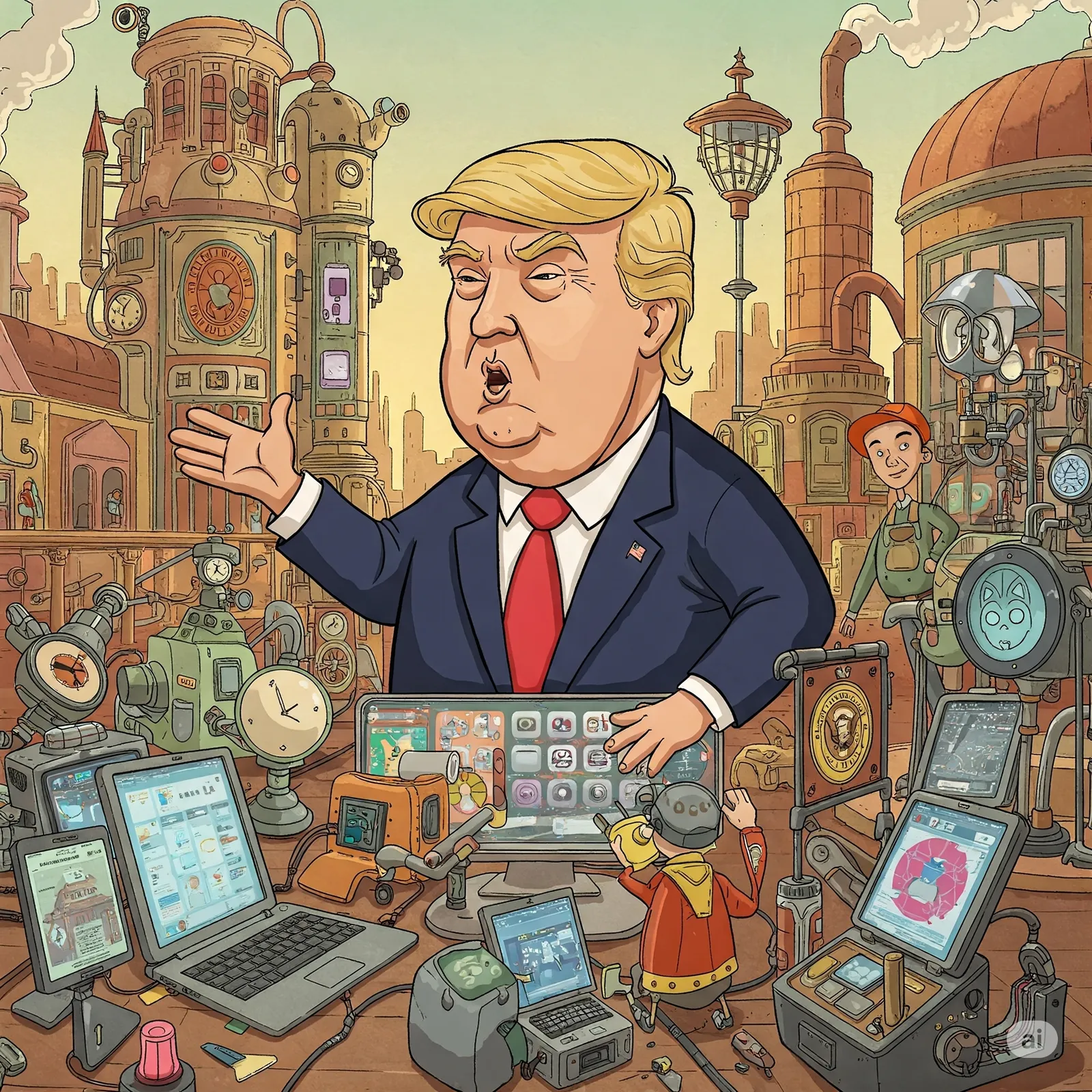
A recent LiveMint article highlighted a disconcerting view. Former U.S. President Donald Trump openly criticized Apple for considering India as an alternative to China for iPhone manufacturing, stating bluntly, "India is not good for manufacturing."
While Apple's Tim Cook defends India’s growing capability, Trump's remarks expose a deeper issue:
🔻 India is increasingly seen as a low-cost assembly center—not a source of innovation.
This perception, whether fair or not, is dangerous. It undermines decades of progress and pigeonholes a billion-strong country as a backend factory instead of a front-end innovator.
⚙️ Manufacturing vs. Innovation: A False Binary
India can absolutely be a manufacturing hub—but that cannot be the end goal. Our aspiration must be to design, invent, and lead, not just assemble someone else’s ideas.
Let’s look at the numbers.
📊 India's Innovation Deficit
As per UNESCO data (2018-19):
56.1% of India’s R&D is funded by the government, compared to just 13.6% in Germany and 3.6% in South Korea.
Only 7.1% of R&D in India comes from business or non-profit enterprises.
Private sector innovation is drastically underpowered, and the country lacks a vibrant startup-university-corporate R&D synergy seen in the U.S., Israel, or even China.
Despite government schemes, India’s Innovation Index rankings reveal deep disparities:
| Top States | Innovation Score |
|---|---|
| Karnataka | 42.5 |
| Maharashtra | 38.03 |
| Tamil Nadu | 37.91 |
| Bihar, Jharkhand etc. | < 18 |
Only a handful of states are truly driving innovation. Most others are stuck in traditional models.
🎨 Why “A” in STEAM Is the Game-Changer
Enter the “A” for Arts—a missing puzzle piece in India's innovation landscape.
A seminal paper shows how art fosters innovation in product development through:
Visual thinking: translating abstract ideas into usable designs
Cross-functional collaboration: combining tech, design, and user empathy
Creative risk-taking: key to real breakthroughs
Storytelling and usability: turning function into human-centered form
A stunning example is Prof. Vijay Natarajan from IISc, who transformed virus structure data into artful 3D visualizations—a tool for science and beauty. This is where R&D meets imagination.
🛠️ From “Make in India” to “Create in India”
The current narrative pushes “Make in India”—which is important—but we must also build a “Create in India” culture.
How?
✅ Policy Shifts Needed:
Rebalance R&D funding to empower universities, startups, and private R&D labs.
Encourage cross-disciplinary education—bring design and critical thinking into engineering colleges.
Celebrate creators, not just coders: support innovation in design, storytelling, and problem-solving.
Foster innovation ecosystems in every state, not just Karnataka or Maharashtra.
Flip the perception: India isn’t just where products are made—it's where ideas are born.
🧭 Final Thoughts: India Must Redesign Its Innovation DNA
The future belongs to countries that don’t just manufacture but reimagine. For India, the real question isn’t whether we can build iPhones—but can we design the next iPhone?
Innovation isn’t a straight line—it’s a loop of logic, creativity, curiosity, and impact. That loop is STEAM, not just STEM.
Let’s stop building only for the world—and start creating from within.
🔗 Sources: