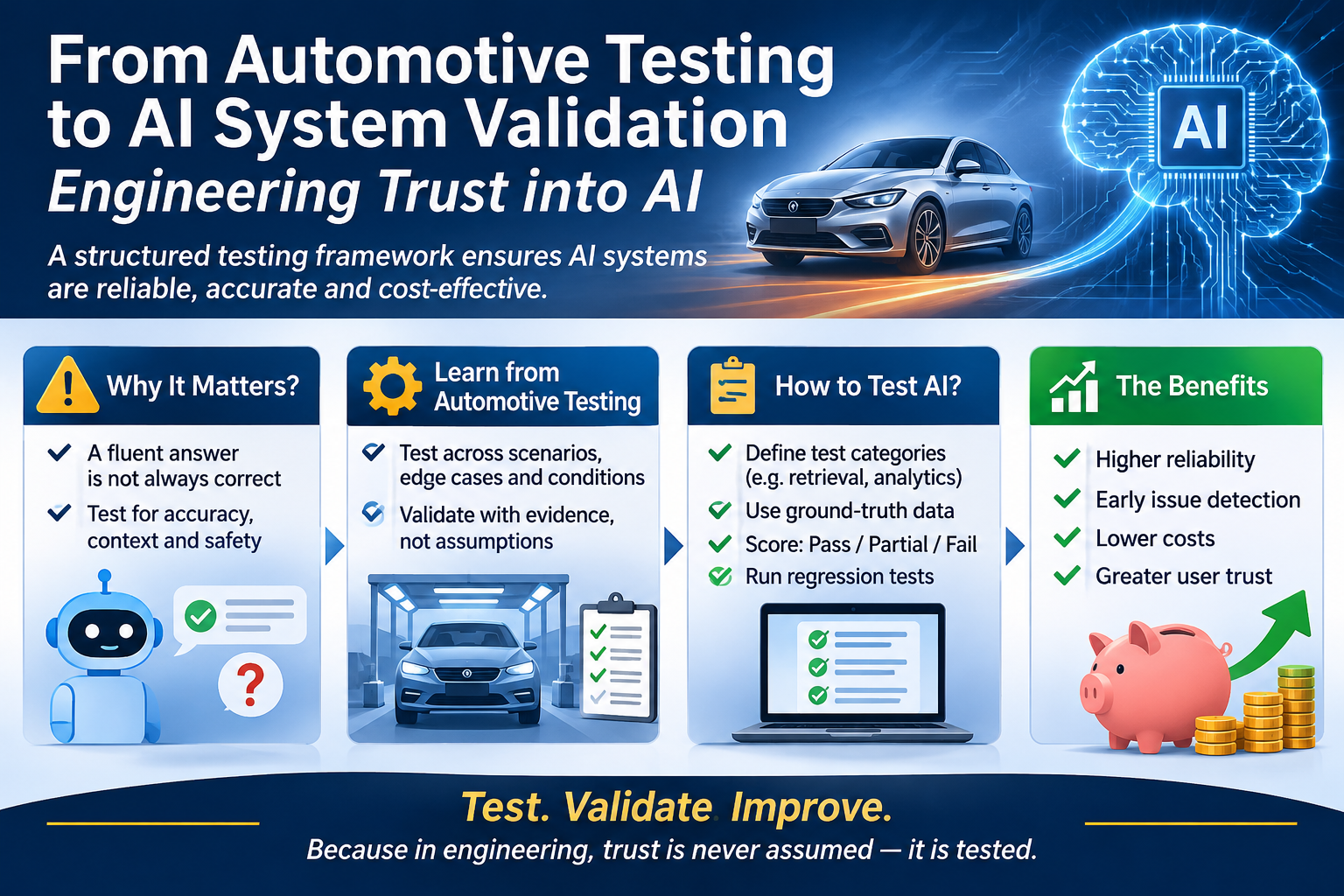
AI systems are becoming part of everyday business operations, from answering customer queries to supporting critical decisions. However, a fluent and confident response does not necessarily mean a correct one. An AI chatbot can retrieve outdated information, miss important context, generate unsupported answers or fail when a user asks an unexpected question. This is why AI testing needs to go beyond checking whether a system works. It must evaluate accuracy, consistency, source traceability, contextual understanding, security and performance. Without a structured testing framework, these issues may only become visible after deployment, when correcting them can be far more expensive.
My perspective on this comes partly from my earlier experience in automotive product development and testing at Maruti Suzuki. Working with vehicle components, sensor data and performance analysis taught me that a product cannot be considered reliable simply because it works under ideal conditions. It needs to be tested across different scenarios, operating conditions and edge cases. Whether analysing cabin air quality or compressor temperature, the objective was to identify deviations early, validate results against evidence and make informed engineering decisions.
I see a strong parallel with AI systems - although the technology is different, the underlying principle remains the same - test systematically before trusting the output.
Recently, while working on an enterprise chatbot testing exercise, I applied a similar approach by developing a set of 74 test queries across seven categories - information retrieval, filtering, trend analysis, recommendations, summarisation, edge cases and follow-up questions.
The testing covered 65 distinct safety alerts containing 533 incidents, alongside 1,844 accident and near-miss log entries. Rather than simply checking whether the chatbot responded, the objective was to verify whether it retrieved the correct information, referenced the right sources, handled ambiguity, retained conversational context and avoided generating unsupported answers. This helped surface practical gaps, including missing indexed content, incorrect references and limitations in handling ambiguous or unusual queries. It also demonstrated why a repeatable test suite is important. Every change to the data, prompts or underlying model should be validated against the same benchmark.
A well-designed AI testing framework can also become a cost optimisation strategy. Identifying retrieval errors or reasoning gaps early can reduce expensive rework, avoid unnecessary model upgrades and limit the operational impact of incorrect AI outputs.
Automated regression tests can further reduce repetitive manual validation, while monitoring response quality, latency and token consumption helps teams understand the real cost of running AI systems. The goal is not to test everything endlessly, but to prioritise tests based on business risk and continuously improve the system using measurable evidence. Moving from traditional product testing to AI system validation has reinforced one important lesson for me- "trust in engineering"