
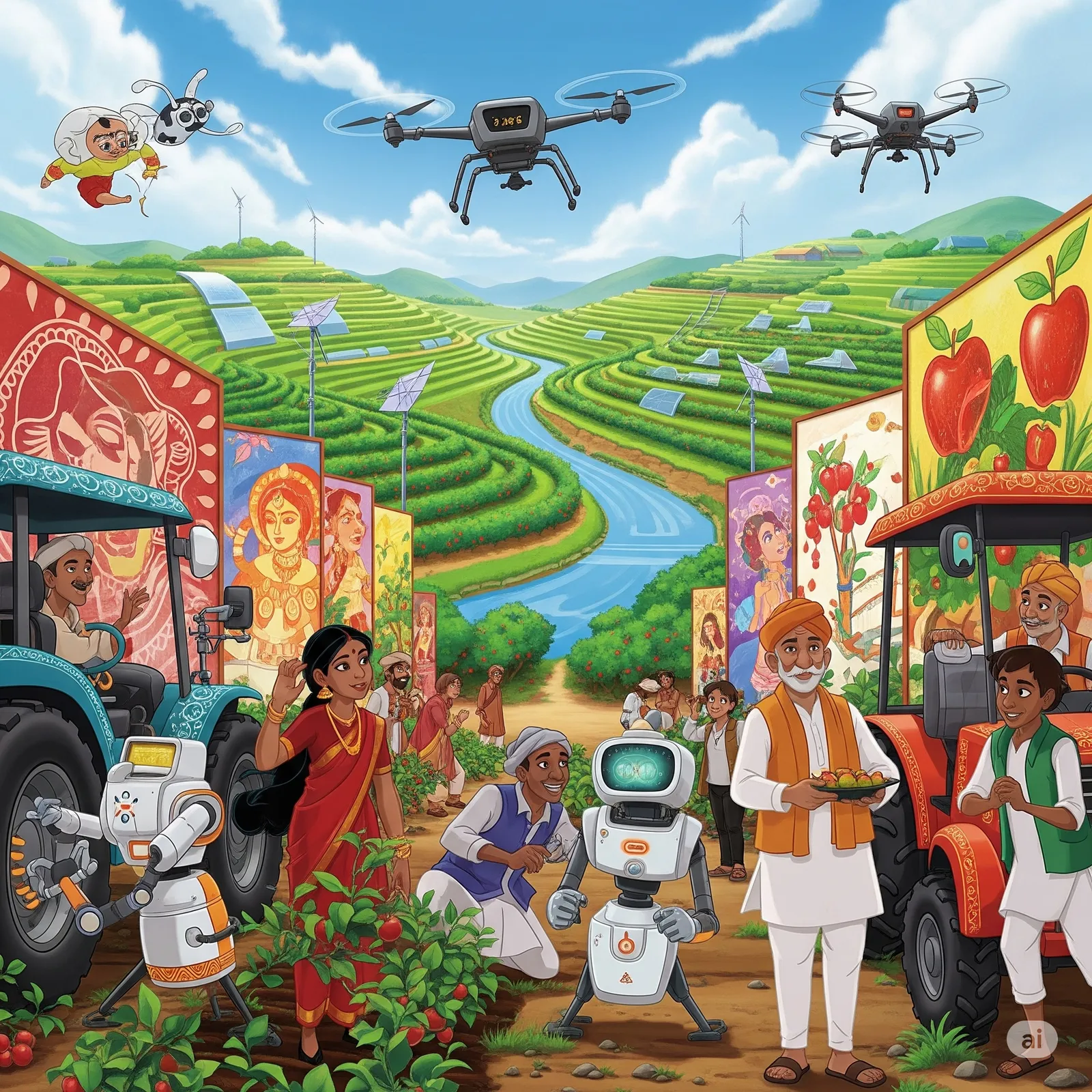
Agriculture technology in India
Innovation doesn’t always need a lab coat. Sometimes, it starts with curiosity, courage, and a seed.”
In the foothills of Himachal Pradesh, far from research labs and agri-tech companies, Hariman Sharma sowed the seeds of a revolution—one that redefined how we understand science, innovation, and sustainability. His creation of the HRMN-99 apple variety, capable of thriving in tropical climates, is more than just a breakthrough in horticulture. It is a masterclass in STEAM: Science, Technology, Engineering, Arts, and Mathematics.
At a time when apples were considered exclusive to cooler regions, Sharma proved that even in high-temperature climates of 40–45°C, apples could blossom—with determination, observation, and experimentation.
🔬 S – Science: Innovation Through Natural Curiosity
The story begins in 1998, when a discarded apple seedling unexpectedly sprouted in Hariman Sharma’s courtyard in Bilaspur, Himachal Pradesh. Instead of ignoring it, Sharma nurtured it—watching closely as it began to grow and fruit. He noticed something extraordinary: this tree was bearing apples without needing traditional chilling conditions.
What followed was not just farming, but scientific method in action. Sharma observed, documented, experimented with grafting, and replicated the variety. His HRMN-99 apple is self-pollinating, requires low chilling, and yields 75 kg per tree per year—an ecological and agricultural marvel.
🧪 T – Technology: From Backyard to Global Fields
Sharma may not have had access to cutting-edge lab equipment, but he mastered the technology of grafting and varietal propagation—a cornerstone of modern horticulture, especially in apple cultivation.
🌱 What is Grafting?
Grafting is a horticultural technique where tissues of two plants are joined together so they continue their growth as one. In this method:
A scion (young shoot or twig of the desired plant) is grafted onto a rootstock (the rooted part of another plant).
This allows the desirable traits of the scion (like taste, disease resistance, or climate tolerance) to grow with the sturdy root system of the rootstock.
Sharma used this traditional yet precise technique to reproduce the HRMN-99 variety from the original plant that sprouted in his backyard—ensuring consistency, quality, and wide-scale distribution.
🌿 What is Varietal Propagation?
Varietal propagation refers to the reproduction of plants to maintain or multiply a specific variety with known traits. This can be done through:
Vegetative methods like grafting or budding
Cuttings or layering in some crops
Sharma used varietal propagation to preserve the genetic integrity of HRMN-99, allowing thousands of farmers to grow identical apple plants that matched the characteristics of the original mother plant—suitable for warm climates, high yield, and self-pollination.
These low-tech but high-impact techniques are replicable and accessible, enabling farmers in diverse geographies—India, Nepal, Bangladesh, Zambia, and Germany—to join a quiet revolution in tropical apple farming.
🛠️ E – Engineering: Designing Solutions from the Soil Up
Agricultural engineering isn’t just about machinery—it’s about systems thinking. Sharma’s practices emphasized:
Soil compatibility and selection
Plant spacing optimization
Micro-irrigation techniques
Pest and nutrient control protocols
He engineered resilient agricultural systems that could thrive even in the face of climate change, water scarcity, and shifting weather patterns. His work represents localized systems engineering rooted in deep ecological knowledge.
🎨 A – Arts: The Narrative Power of Farming
Farming is an art—of observation, patience, and vision. Sharma not only innovated scientifically but also inspired emotionally. His story has become a symbol of rural creativity, reminding us that art doesn't just hang in galleries—it grows in fields.
There is poetry in the way he tells his story: how a seed became a tree, a tree became hope, and hope became a movement. His journey has been covered in documentaries, news stories, and honored by the President of India with the Padma Shri in 2017.
His life shows that agriculture is an expressive medium—one that combines hands, hearts, and minds.
📊 M – Mathematics: Data-Driven Yields and Impact
Innovation without data is guesswork. Sharma kept records of:
Yield per tree
Tree survival rates
Temperature ranges
Expansion across geographies
These insights helped validate his claims to scientific bodies and support further research-led propagation of HRMN-99. With an average yield of 75 kg per tree per year, and adaptability in 40+°C, Sharma provided a mathematical model for profitability and sustainability in hot-climate fruit farming.
🍏 Apple Varieties Grown in India – A Comparative Table
| Apple Variety | Major Growing States | Ideal Temperature Range (°C) | Chilling Requirement |
|---|---|---|---|
| HRMN-99 | Himachal Pradesh, UP, Bihar, Jharkhand, MP | 10–45°C | Low (Tropical & Sub-tropical suitable) |
| Red Delicious | Himachal Pradesh, Jammu & Kashmir | 4–24°C | High (800–1,000 chilling hours) |
| Royal Delicious | Himachal Pradesh, Uttarakhand | 4–22°C | High |
| Golden Delicious | Jammu & Kashmir, Himachal Pradesh | 2–22°C | High (800+ chilling hours) |
| Ambri (Desi) | Jammu & Kashmir | 4–25°C | Medium |
| Tydeman's Early | Himachal Pradesh, Uttarakhand | 5–20°C | Moderate |
| Fuji | Himachal Pradesh, North-East India (trial) | 10–25°C | Moderate to high |
| Granny Smith | Experimental – Himachal/Uttarakhand | 4–20°C | High |
| Macintosh | Jammu & Kashmir (select orchards) | 2–22°C | High (cold-hardy variety) |
🧠 Insight: Most traditional varieties require cold winters (chilling hours) to break dormancy. In contrast, HRMN-99 is a low-chilling variety, enabling apple cultivation in India's tropical and sub-tropical regions.
🎓 A Call to Action: Make STEAM Rooted in Soil
Sharma's story offers a powerful lesson for students, educators, and innovators:
In today’s world where we champion STEM and STEAM education, why not introduce students to figures like Hariman Sharma? Why not inspire them to:
Create films and animations based on grassroots innovators
Build apps that help spread indigenous innovations
Use mathematical modelling to study local agriculture
Write children’s books or short stories on farmers as heroes
The True Face of Indian Innovation
Hariman Sharma didn’t just grow apples—he grew possibilities. He proved that true innovation isn’t about resources—it’s about resourcefulness. His life’s work is a shining example of how STEAM is not just academic—it is alive, local, and life-changing.
Let’s take his legacy to our classrooms, labs, studios, and startups. Let’s turn STEAM into something rooted in the Indian soil—as Hariman Sharma did with a single apple tree.
📚 References
Department of Science and Technology (DST), Government of IndiaPadma Shri Hariman Sharma – The Apple Man of India
The Indian Express‘Apple Man of India’ Padma Shri awardee Hariman Sharma and his unique variety that grows in plains
The Economic TimesHimachal farmer Hariman Sharma selected for Padma Shri; revolutionised apple cultivation
National Innovation Foundation – India (NIF)[Profile and dissemination of HRMN-99 apple variety]
Indian Council of Agricultural Research (ICAR) and state horticulture departmentsData and practices related to apple cultivation and varietal requirements.
Basic Horticulture ScienceDefinitions of grafting and propagation methods adapted from standard textbooks and extension materials.