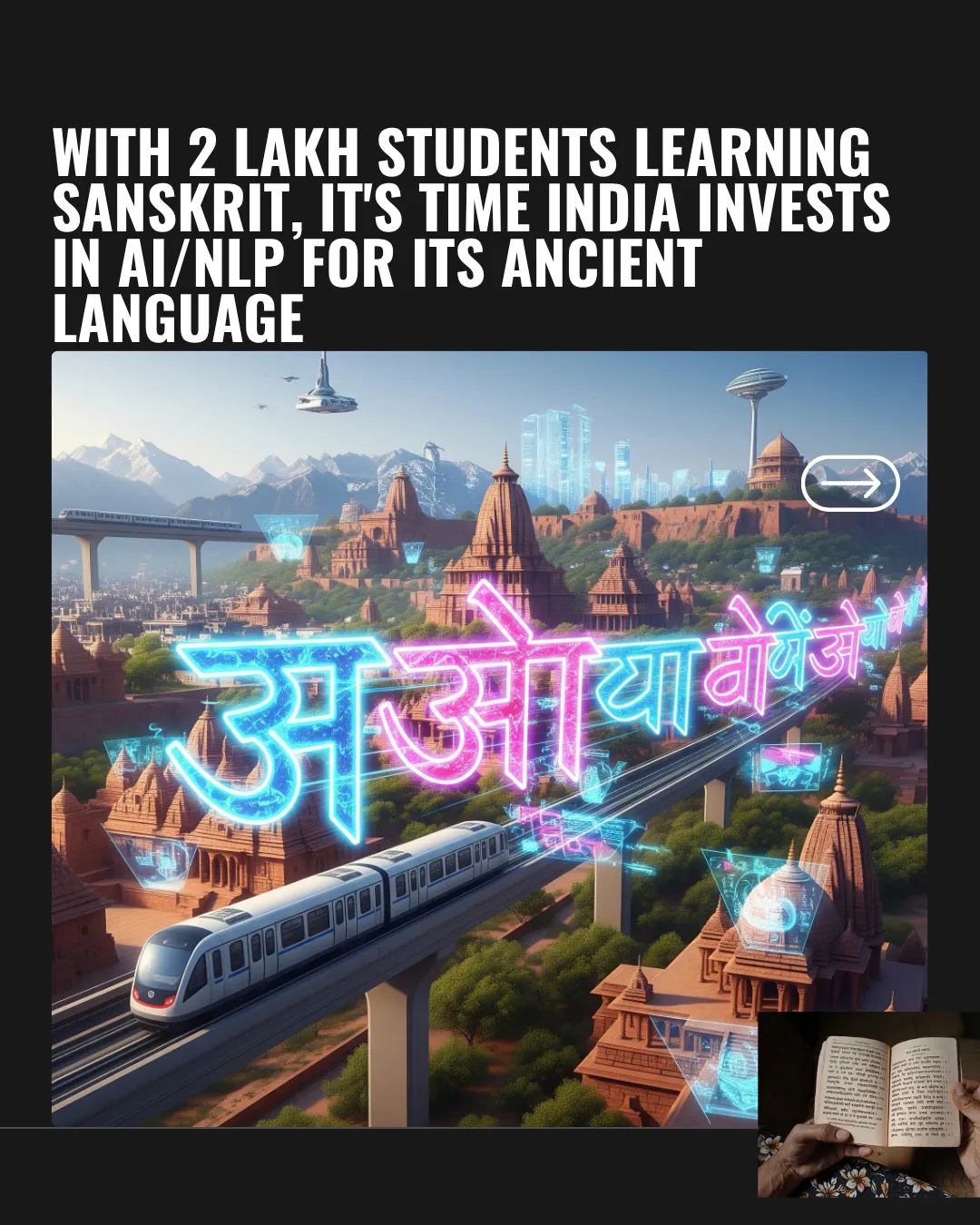
In an age of Artificial Intelligence, quantum computing, and linguistic models, Sanskrit—one of the world's oldest languages—is making a futuristic comeback. Once the foundation of ancient Indian knowledge systems, Sanskrit is now being explored as a potential coding language due to its grammatical precision, phonetic clarity, and logical structure.
Even global tech giants are recognizing its potential. In 2023, Google AI India launched a pilot project to include Sanskrit in its training corpora for natural language models—marking a key shift in how the language is viewed not just culturally but computationally.
But this isn't just nostalgia—this is a STEAM (Science, Technology, Engineering, Arts, Mathematics) renaissance in action. Sanskrit is poised to become a bridge between tradition and technology, especially when introduced through engaging storytelling, art, and logic-driven platforms.
📊 Sanskrit Today: A Language of the Past… or the Future?
👥 Current Sanskrit speakers: As per Census 2011, approximately 25,000 people in India report Sanskrit as their mother tongue, but the number of learners is much larger and steadily growing.
🏫 Schools teaching Sanskrit:
As per Ministry of Education data (2022), over 12,000 government and private schools in India offer Sanskrit as a subject, especially under CBSE, ICSE, and state boards.
India alone has over 2 lakh students enrolled in Sanskrit in 2020, formally or informally.
NEP 2020 emphasizes Sanskrit as part of holistic and experiential learning, encouraging its introduction from Grade 6 onwards.
🌍 Growing market of Sanskrit learners:
Global institutions such as Oxford, Harvard, and Heidelberg University offer Sanskrit courses.
Interest in Sanskrit is growing in countries like Germany, the USA, and Japan, largely driven by interests in yoga, Ayurveda, philosophy, and computational linguistics.
Online platforms (Coursera, Udemy, Chinmaya Mission, etc.) see thousands of enrollments annually from non-Indian learners.
📈 Why Sanskrit’s consumer base will rise:
Demand for culturally rooted yet futuristic learning in India.
Rise of AI and NLP tools needing structured ancient languages for training.
Expanding EdTech platforms offering Sanskrit-based coding and grammar tools.
Increasing use in spiritual tourism, wellness education, and cultural exports like mantras, rituals, and Vedic sciences.
💻 Sanskrit as a Coding Language: Why It’s Technically Powerful
Sanskrit isn’t just poetic—it’s highly structured and rule-based, which makes it compatible with modern computing:
🧬 Paninian Grammar: A 4th-century BCE grammar system with near-computational precision. NASA once explored it for building AI models.
⚙️ Ambiguity-free syntax: Unlike natural languages, Sanskrit’s rigid structure can be interpreted by machines with minimal confusion.
📂 Contextual encoding: Roots, prefixes, and suffixes form modular words—mirroring object-oriented programming.
“Sanskrit is the only language known to be suitable for AI-level unambiguous semantic representation.” — NASA research (1985)
🧪 Ongoing Research on Sanskrit in Tech
India and the world are investing heavily in Sanskrit-based computational linguistics and technology research.
🔍 Active Research Projects (India & Abroad)
| Institution/Country | Focus Area | Status |
|---|---|---|
| IIT Kharagpur (India) | Sanskrit Digital Corpus, AI grammar parsing | Active since 2017 |
| IIIT Hyderabad (India) | Sanskrit NLP, machine translation | Ongoing since 2016 |
| MIT (USA) | Computational grammar models based on Panini | Research collaborations |
| University of Zurich (Switz.) | Sanskrit syntax and its computational logic | Published papers |
| IGNCA + Digital India | Digitization of Vedic manuscripts | Over 20,000 texts scanned |
| Rashtriya Sanskrit Sansthan | AI-compatible Sanskrit grammar modules | Funded, under progress |
| Google AI India | Sanskrit training corpora for LLMs | Pilot phase (2023–) |
📊 Statistics
🔬 Over 45+ academic institutions in India are researching Sanskrit tech integration.
📘 1000+ scholarly papers published globally in last decade on Sanskrit grammar & computation.
💻 10+ Sanskrit-based apps and AI tools developed in India since 2020.
🛡️ Sanskrit Texts: India’s Intellectual Property
India’s ancient Sanskrit manuscripts and linguistic frameworks are a goldmine of cultural, philosophical, and scientific knowledge. These are more than texts—they are intellectual property (IP) with global relevance.
Why India Must Own and Promote It:
Sanskrit is India's civilizational and technological asset.
🧠 Preserving and using these texts secures India's stake in global AI ethics and language diversity.
📈 Promoting Sanskrit tech boosts research visibility, innovation funding, and national pride.
🌐 If India doesn’t leverage it, global AI models might commercialize it without context or consent.
🎨 Sanskrit as an Artistic Language
Sanskrit’s power lies in brevity, rhythm, and multidimensional meaning:
🔉 Poetic symmetry: Verses (shlokas) can be palindromic or read in multiple ways (chitrakavya).
🎭 Cultural narratives: Drama, music, and dance texts like Natyashastra were all composed in Sanskrit.
🧘 Philosophical depth: Abstract ideas like consciousness, space-time, and ethics are encoded in poetic sutras.
Sanskrit, therefore, blends art and logic—perfect for STEAM integration.
👩💻👦 How India Can Make Sanskrit Cool for Teenagers
To bring Sanskrit into the mainstream, especially among teens, India must combine STEAM education with creativity and coding:
🎯 Strategies for Boosting Sanskrit among Youth:
Gamify Sanskrit learning – Mobile apps that blend Duolingo-style Sanskrit + coding challenges.
Integrate Sanskrit in AI Clubs & Hackathons – Use Sanskrit for chatbot building, grammar-based parsers, and voice tech.
STEAM storytelling projects – Encourage kids to write interactive Sanskrit comics, poems, or digital plays.
Coding with Sanskrit Grammar Engines – Introduce projects where kids write pseudo-code in Sanskrit syntax.
YouTube & Social Media Content – Popularize Sanskrit rap, spoken poetry, and animations for cultural relatability.
🚀 What’s Next?
India is at the intersection of ancient knowledge and modern innovation. By merging Sanskrit’s scientific grammar with the logical rigor of programming, we can inspire a new generation of thinkers, creators, and coders.
Sanskrit is not just a language. It’s a mindset—rooted in logic, creativity, and clarity.
If we can teach coding in Python, we can definitely teach logical thinking through Sanskrit, making it both a cultural and technological force for the 21st century.
📚 References
Census of India, 2011 – https://censusindia.gov.in
NASA Study on Sanskrit and AI (Rick Briggs, 1985) – Knowledge Representation in Sanskrit and Artificial Intelligence
Ministry of Education, NEP 2020 – https://www.education.gov.in
IIT Kharagpur Digital Corpus Initiative – https://www.iitkgp.ac.in
IIIT Hyderabad Sanskrit NLP Work – https://ltrc.iiit.ac.in
IGNCA Digital Manuscript Mission – https://ignca.gov.in
Rashtriya Sanskrit Sansthan Reports – http://sanskrit.nic.in
Google AI India Language Inclusion Pilot – https://ai.google
Education Times article on Sanskrit learners – https://www.educationtimes.com/article/careers-arts/78490861/sanskrit-can-help-explore-new-dimensions?utm_source=chatgpt.com