How Heuristic Algorithms and Machine Learning Converge in Modern RAG Systems

While experimenting with modern Retrieval-Augmented Generation (RAG) systems, one interesting observation emerged- concepts that are often studied separately in computer science - Machine Learning and Heuristic Algorithms, actually converge inside production AI systems.
Machine Learning focuses on learning patterns and representations from data. For example, embedding models transform text, images, or other information into numerical representations where semantically similar concepts are located close together. This capability allows AI systems to understand that phrases such as "electric vehicle battery degradation" and "EV battery health monitoring" represent related concepts, even though they may not share the exact same words.
However, understanding meaning is only one part of the problem. Modern enterprise applications may contain millions or even billions of documents. Once information has been converted into embeddings, another challenge appears: how do we efficiently search through this enormous semantic space?
This is where heuristic algorithms become essential. While machine learning helps create a meaningful representation of knowledge, heuristic algorithms help navigate that representation efficiently. This relationship between learning and search forms the foundation of modern retrieval systems.
HNSW: The Algorithm That Makes Large-Scale Vector Search Possible
A simple way to understand this challenge is to imagine searching inside a library containing millions of books. A human librarian does not read every book before answering a question. Instead, they use an organised approach: first identifying the correct section, then the shelf, and finally the specific pages.
HNSW (Hierarchical Navigable Small World) works with a similar philosophy. It is an Approximate Nearest Neighbour (ANN) search algorithm designed to quickly identify vectors that are most similar to a query without comparing against every single stored vector.
Instead of creating a flat list of embeddings, HNSW organises vectors into a multi-layer graph structure. The upper layers contain fewer nodes and act like express highways, allowing the search process to quickly move across large areas of the dataset. As the search moves downward, the layers become denser and allow more precise local exploration.
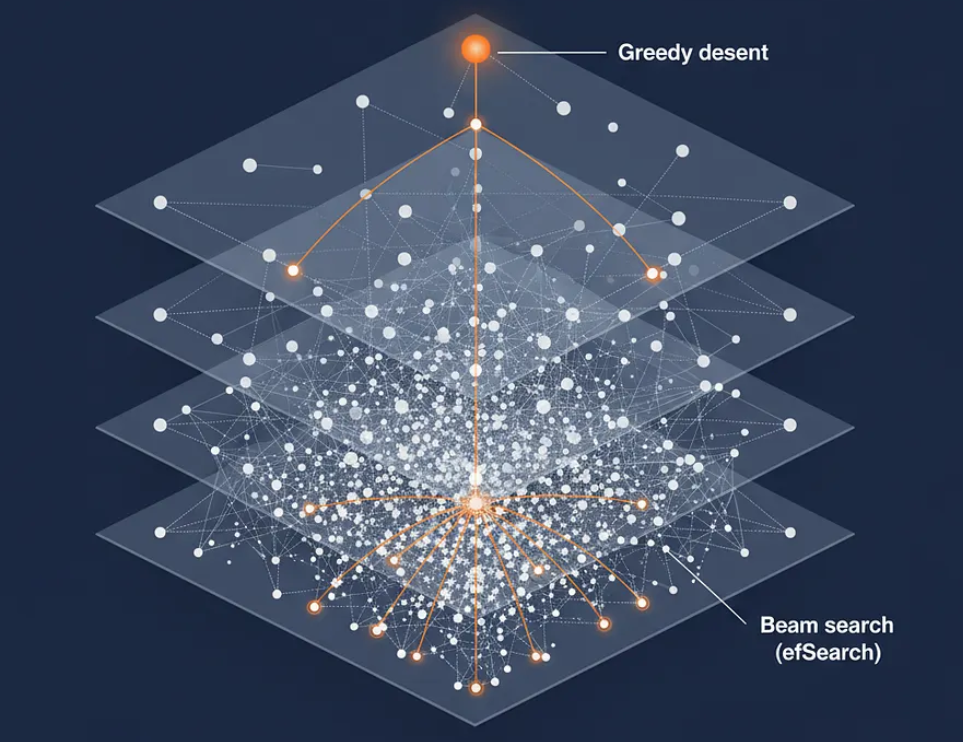
The algorithm uses heuristic decisions to balance speed and accuracy. Parameters such as M, efConstruction, and efSearch control how connected the graph is and how aggressively the search explores possible candidates. Increasing accuracy generally requires more memory or computation, while reducing computation improves latency but may slightly reduce recall.
This is the core philosophy of heuristic algorithms: instead of guaranteeing the mathematically perfect solution through exhaustive search, they provide a highly accurate solution within practical computational limits.
How Modern RAG Systems Use HNSW
Although HNSW is a powerful retrieval algorithm, it is only one component of a complete RAG architecture. Modern RAG systems combine multiple techniques because different retrieval methods solve different problems.

The embedding model provides semantic understanding, but HNSW provides efficient navigation through the embedding space. At the same time, traditional information retrieval algorithms such as BM25 remain valuable because they perform extremely well when users search for specific terms, names, IDs, or technical keywords.
Therefore, many enterprise RAG systems use hybrid retrieval: combining vector similarity search with keyword search. The results from different retrieval methods can then be combined using techniques such as Reciprocal Rank Fusion (RRF). Finally, a reranking model evaluates the smaller candidate set more deeply before the information reaches the LLM.
The important architectural insight is that the LLM is usually the final reasoning layer, not the search engine. Most of the intelligence in a reliable RAG system comes from the pipeline before the LLM: indexing, retrieval, filtering, ranking, and context selection.
Why Understanding Heuristics Matters for AI Engineering
One of the biggest lessons from building RAG applications is that modern AI systems are not powered by machine learning alone. They are a combination of multiple engineering disciplines working together.
Machine Learning answers:
"What information is semantically meaningful?"
Heuristic algorithms answer:
"How can we find that information efficiently?"
Information retrieval answers:
"Which information is most relevant?"
Software architecture answers:
"How can we make this reliable and scalable?"
The same principles appear across modern AI systems. Agentic AI workflows use planning heuristics to decide which tools to call. Search systems use approximate algorithms to reduce computational cost. Recommendation systems use ranking algorithms to balance relevance and diversity.
Understanding heuristics therefore provides an important architectural perspective. It helps engineers move beyond simply selecting a powerful LLM and instead design complete AI systems where every component has a specific responsibility.
The AI engineering not only depend on larger models, It depend on how effectively we combine learning algorithms, search algorithms, optimisation techniques, and software architecture to build intelligent systems that can operate efficiently at scale.
References
Malkov, Y. A., & Yashunin, D. A. (2018). Efficient and Robust Approximate Nearest Neighbor Search Using Hierarchical Navigable Small World Graphs.
Lewis et al. (2020). Retrieval-Augmented Generation for Knowledge-Intensive NLP Tasks.
Manning, C. D., Raghavan, P., & Schütze, H. Introduction to Information Retrieval.
Johnson, J., Douze, M., & Jégou, H. (2017). Billion-scale similarity search with GPUs.
Microsoft Azure AI Search Documentation — Vector Search, Hybrid Search and Semantic Ranking.
Google Research. ScaNN: Efficient Vector Similarity Search at Scale.
Microsoft Research. DiskANN: Fast Accurate Billion-point Nearest Neighbor Search on a Single Node.


Comments