Why India Needs More STEAM Teachers: The Missing Link Between Education and Innovation
- Uttam Sharma
- Jun 11, 2025
- 3 min read

In today’s rapidly evolving world, innovation no longer belongs solely to coders or engineers. It thrives at the intersection of science and art, of technology and creativity, of engineering and empathy. This is why STEAM—Science, Technology, Engineering, Arts, and Mathematics—is the future of education.
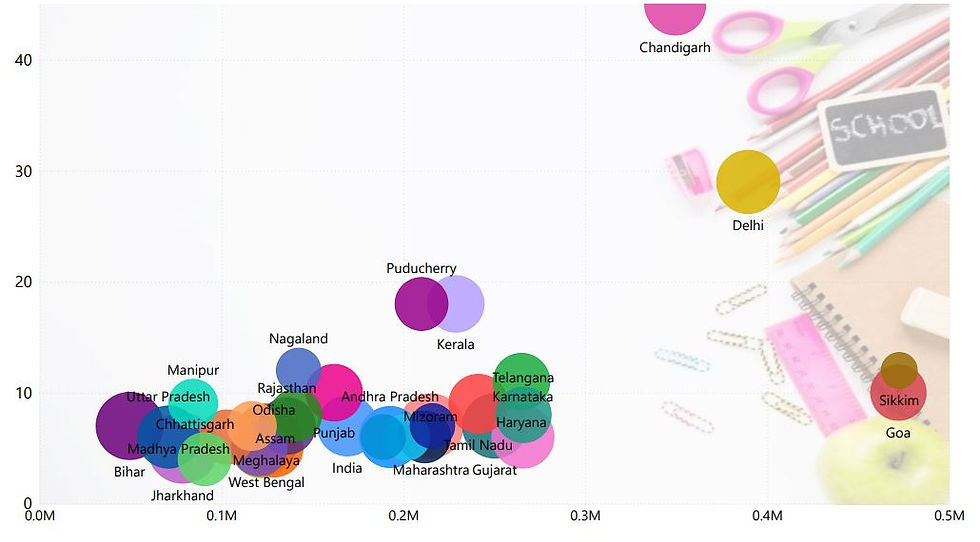
A recent analysis by "Mix it with the Arts" - of India's education data and income data reveals a powerful truth: states with better teacher support systems—more teachers per school and lower student-teacher ratios—also have higher per capita incomes and greater innovation capacity.
Yet, India still lags behind in deploying qualified STEAM educators, especially in public schools. And this could be the bottleneck to becoming a global innovation leader.
📊 India’s Education-Income Gap: What the Numbers Say
Here's how some Indian states compare when it comes to teacher density and income:
State | Per Capita Income (₹) | Teachers per School | Student-Teacher Ratio |
Sikkim | ₹4,72,543 | 12 | 8 |
Goa | ₹4,72,070 | 10 | 21 |
Delhi | ₹3,89,529 | 29 | 28 |
Chandigarh | ₹3,49,373 | 45 | 26 |
Bihar | ₹49,470 | 7 | 32 |
Jharkhand | ₹78,660 | 5 | 35 |
Uttar Pradesh | ₹70,792 | 6 | 27 |
High-income states have better STEAM education potential: more teachers, more individualized learning, and more diversity in subjects. In contrast, under-resourced states suffer from crowded classrooms and limited teacher specialization, especially in the arts and technical disciplines.
🌍 Global Comparison: Where India Stands in STEAM
Let’s stack India’s teacher support against leading innovative nations:
Country | Avg. Student-Teacher Ratio | Teachers Trained in STEAM (%) | Per Capita Income (USD) |
Finland | 11:1 | 85% | $53,000 |
South Korea | 16:1 | 78% | $34,000 |
USA | 15:1 | 76% | $80,000 |
India | 25:1 (avg) | <15% (estimated by MIWA) | ~$2,000 |
India’s average student-teacher ratio stands at 25:1, but can shoot up to 35:1 in some states. Additionally, less than 15% of Indian teachers have any formal exposure to STEAM disciplines. This gap, if unaddressed, can seriously hamper the country’s long-term innovation capacity.
🎨 The "A" in STEAM: Why Arts Matter for Innovation
Contrary to traditional views, art is not extracurricular—it is core to creativity and design thinking. Here’s how:
Visual arts enhance observation, pattern recognition, and aesthetics—key in product and UX design.
Music improves mathematical thinking and rhythm perception.
Theatre and storytelling cultivate empathy and narrative building, essential for leadership and branding.
Design and architecture blend engineering with human-centered thinking.
Major companies like Apple, Tesla, and IKEA have credited their success to design thinking—a direct output of STEAM-driven education.
“Creativity is just connecting things.” — Steve Jobs
In STEAM, the arts don’t dilute science—they amplify it. And for a country as diverse as India, embedding this fusion in education is a game-changer.
🔍 Why India Must Urgently Invest in STEAM Teachers
✅ Low Teacher Density in High-Burden States
Uttar Pradesh (25 lakh teachers for 4.16 crore students) and Bihar (6.5 lakh teachers for 2.1 crore students) need urgent attention.
✅ STEM Isn’t Enough—Add the A
Training in pure sciences is common, but creative application is missing. India's next billion-dollar innovations will likely require design, psychology, ethics, and storytelling.
✅ STEAM = Economic Growth
States with higher teacher density and STEAM resources—Goa, Sikkim, Delhi—show higher per capita income. It’s time to scale this model nationally.
🚀 The Path Forward: Building a STEAM-Ready India
Hire more teachers—with at least 30% specialized in STEAM fields.
Modernize teacher training institutes to include art, design, AI, and interdisciplinary thinking.
Revise curricula to make STEAM central to both primary and secondary education.
Fund state-level innovation hubs that combine local arts with global science (e.g., bio-design, agro-tech, craft-tech, etc.).
💬 Final Word
If India wants to be the world’s innovation factory, it must first become its STEAM powerhouse. That means more teachers, better training, and schools that embrace not just logic and numbers—but also empathy, design, and imagination.
Let’s stop asking whether a child will be an engineer or an artist.
Let’s create a system where they can be both.
📚 Sources :
UDISE+ (2022-23) Education Data
World Bank Education Statistics
OECD Education Report 2023
National Education Policy (NEP) 2020 Highlights
MoSPI Per Capita Income Estimates


Comments