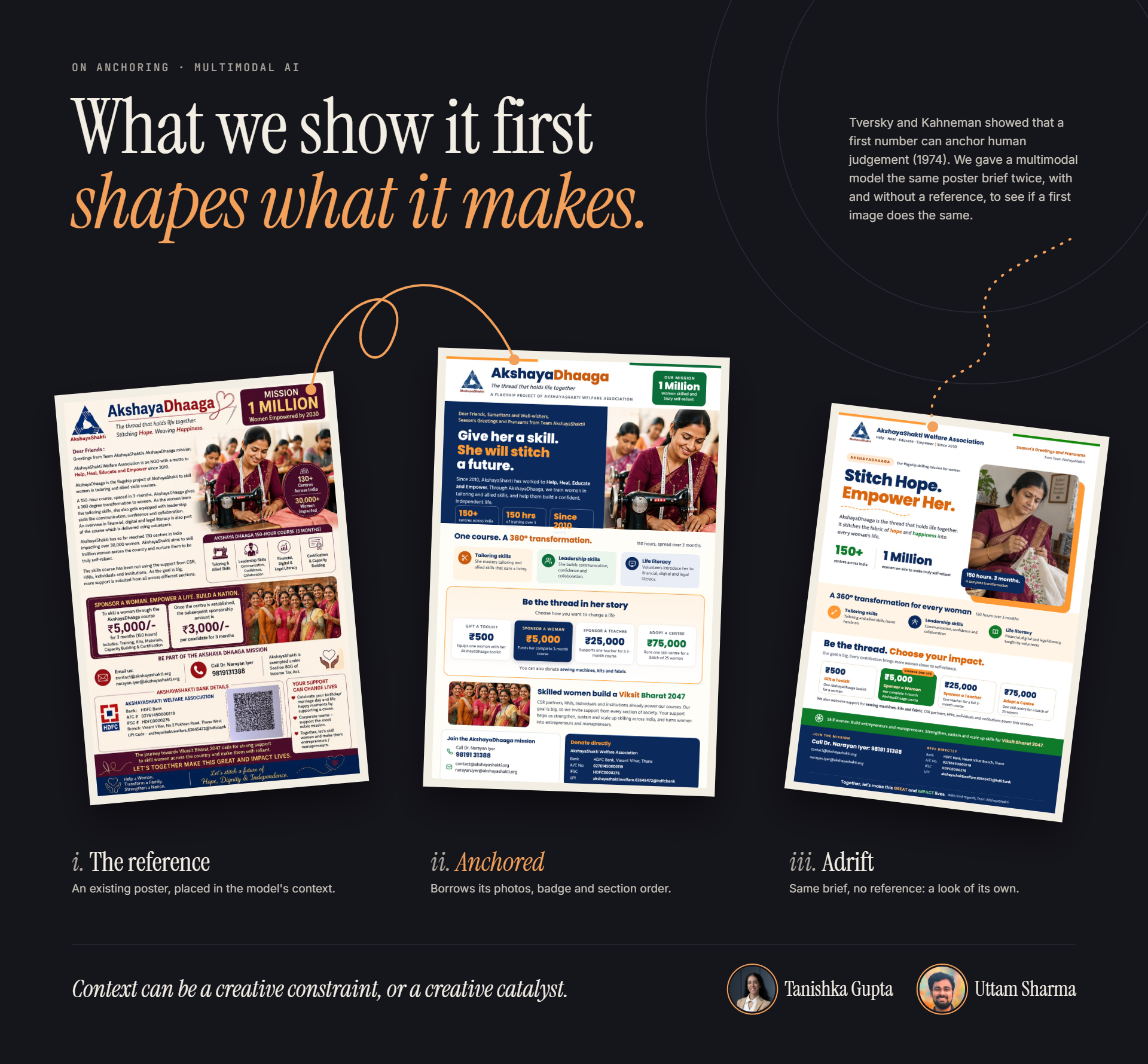
Imagine asking a multimodal AI system to design a poster for an upcoming art and technology event. The brief is simple - create something visually engaging, communicate the event's theme, and make it suitable for a professional audience.
Now, consider two different approaches. In the first, you provide the model with a reference poster, while, in the second, you provide the same brief but do not attach any reference. Even though the actual requirement has not changed, the resulting designs may look remarkably different. The AI may carry elements of the visual language, composition, colour palette or aesthetic of the reference into its output. This raises an interesting question.
Are we witnessing a technological version of the Anchoring Effect, a cognitive bias in which the first piece of information influences subsequent judgements?
The anchoring effect was extensively studied by Amos Tversky and Daniel Kahneman in their influential 1974 paper, Judgment under Uncertainty: Heuristics and Biases. Their research demonstrated how an arbitrary initial reference point could influence people's subsequent numerical estimates. In human creativity, a similar influence can emerge when an artist encounters a particular visual reference before beginning a design. That reference may unconsciously shape their choice of colours, composition and visual direction. With multimodal Large Language Models (LLMs), the underlying mechanism is different, but the conceptual parallel is interesting. Images, textual instructions and previous interactions become part of the context through which a model interprets a creative task.
Research by Wardle and Sušnjak (2025), Image First or Text First? Optimising the Sequencing of Modalities in Large Language Model Prompting and Reasoning Tasks, found that the order in which images and text are presented can influence multimodal model performance. Their findings reinforce an important point: the sequence and structure of information matter, not just the information itself.
However, there is an important distinction between psychological anchoring and computational context conditioning. Humans rely on cognitive shortcuts, prior experiences and subconscious associations, whereas multimodal AI systems process visual and textual inputs through learned representations and computational mechanisms. An AI system does not necessarily become psychologically attached to its first reference image. Instead, the reference becomes part of the information conditioning its response. It is important to be aware of this distinction when designing creative AI workflows. If we repeatedly provide the same visual references, we may unintentionally narrow the creative possibilities of the model. Conversely, introducing contrasting references, asking for alternative interpretations, or initially providing the design brief without visual examples may encourage a broader exploration of possibilities. In other words, the way we frame a creative problem can influence not only what the AI produces, but also the range of creative directions we explore through it.
This is where our mind wandered off. If context can shape what AI creates, could we feed it enough human experience that it “actually” starts to feel? A team of 19 researchers, including Yoshua Bengio, checked today's AI against the leading theories of consciousness and found no current system that qualifies, although they saw no obvious barrier to building one someday (Butlin et al., 2023). Others sound far more doubtful. Neuroscientist Anil Seth and his colleagues describe language models as mirrors that reflect our collective digital past (AI Weekly).
Feeding AI more of our experiences might just give us a clearer mirror, not a mind. And even if a mind did appear, how would we know? One can't prove their best friend feels things either. One simply trusts it, because she's like me. So, if an AI one day tells us it's hurting, would we believe it?
On paper, AI already reads emotions better than most of us. In a 2025 study, six AI models scored 82% on emotional intelligence tests, while people averaged 56% (University of Geneva, 2025). So, the understanding side of EI and EQ, noticing what someone feels and knowing how to respond, is something AI can do, and something any of us can learn.
But understanding doesn't tell the whole story. Researchers showed over 6,000 people the exact same supportive messages, and people rated them as more caring and authentic when they believed a human wrote them. Many would even wait days or weeks for a human reply rather than get an instant one from AI (Rubin et al., Nature Human Behaviour, 2025). What we crave is someone who chose to feel it with us. Understanding takes you far, and being human takes you the rest of the way. So, if a perfect response can't replace a person who shows up, what exactly are we giving when we show up for someone?
Perhaps the bigger takeaway is that context is not merely background information; it can become a creative constraint or a creative catalyst.
In human psychology, recognizing anchoring bias helps us question our first impressions. In AI development, understanding contextual influence encourages us to become more deliberate about prompt design, reference selection and multimodal context engineering. As we increasingly collaborate with AI to create visual identities, presentations, posters and digital experiences, perhaps we should experiment not only with what we ask AI to create, but also with what we show it before asking. After all, when human creativity meets artificial intelligence, is the final output entirely a reflection of our imagination, or partly a reflection of the first thing we showed the machine? OR (Do the references and prompts we give AI expand our creativity, or do they quietly keep it inside boundaries we don't even notice?)
References
Tversky, A. & Kahneman, D. (1974). Judgment under Uncertainty: Heuristics and Biases. Science, 185(4157), 1124–1131. https://doi.org/10.1126/science.185.4157.1124
Wardle, G. & Sušnjak, T. (2025). Image First or Text First? Optimising the Sequencing of Modalities in Large Language Model Prompting and Reasoning Tasks. Big Data and Cognitive Computing, 9(6), 149. https://doi.org/10.3390/bdcc9060149.
Wu, J. et al. (2024). Visual Prompting in Multimodal Large Language Models: A Survey. https://arxiv.org/abs/2409.15310.
AI Weekly (2026) ‘Seth, Block, Tononi: AI consciousness “extraordinarily unlikely”’, AI Weekly. Available at: https://aiweekly.co/alerts/seth-block-tononi-ai-consciousness-extraordinarily-unlikely
Butlin, P., Long, R., Elmoznino, E., Bengio, Y., Birch, J., Constant, A., Deane, G., Fleming, S.M., Frith, C., Ji, X., Kanai, R., Klein, C., Lindsay, G., Michel, M., Mudrik, L., Peters, M.A.K., Schwitzgebel, E., Simon, J. and VanRullen, R. (2023) ‘Consciousness in artificial intelligence: insights from the science of consciousness’, arXiv preprint, arXiv:2308.08708. Available at: https://arxiv.org/abs/2308.08708
Rubin, M., Li, J., Zimmerman, F., Ong, D.C., Goldenberg, A. and Perry, A. (2025) ‘Comparing the value of perceived human versus AI-generated empathy’, Nature Human Behaviour. doi: 10.1038/s41562-025-02247-w.
Schlegel, K., Sommer, N.R. and Mortillaro, M. (2025) ‘Large language models are proficient in solving and creating emotional intelligence tests’, Communications Psychology, 3(1). doi: 10.1038/s44271-025-00258-x.